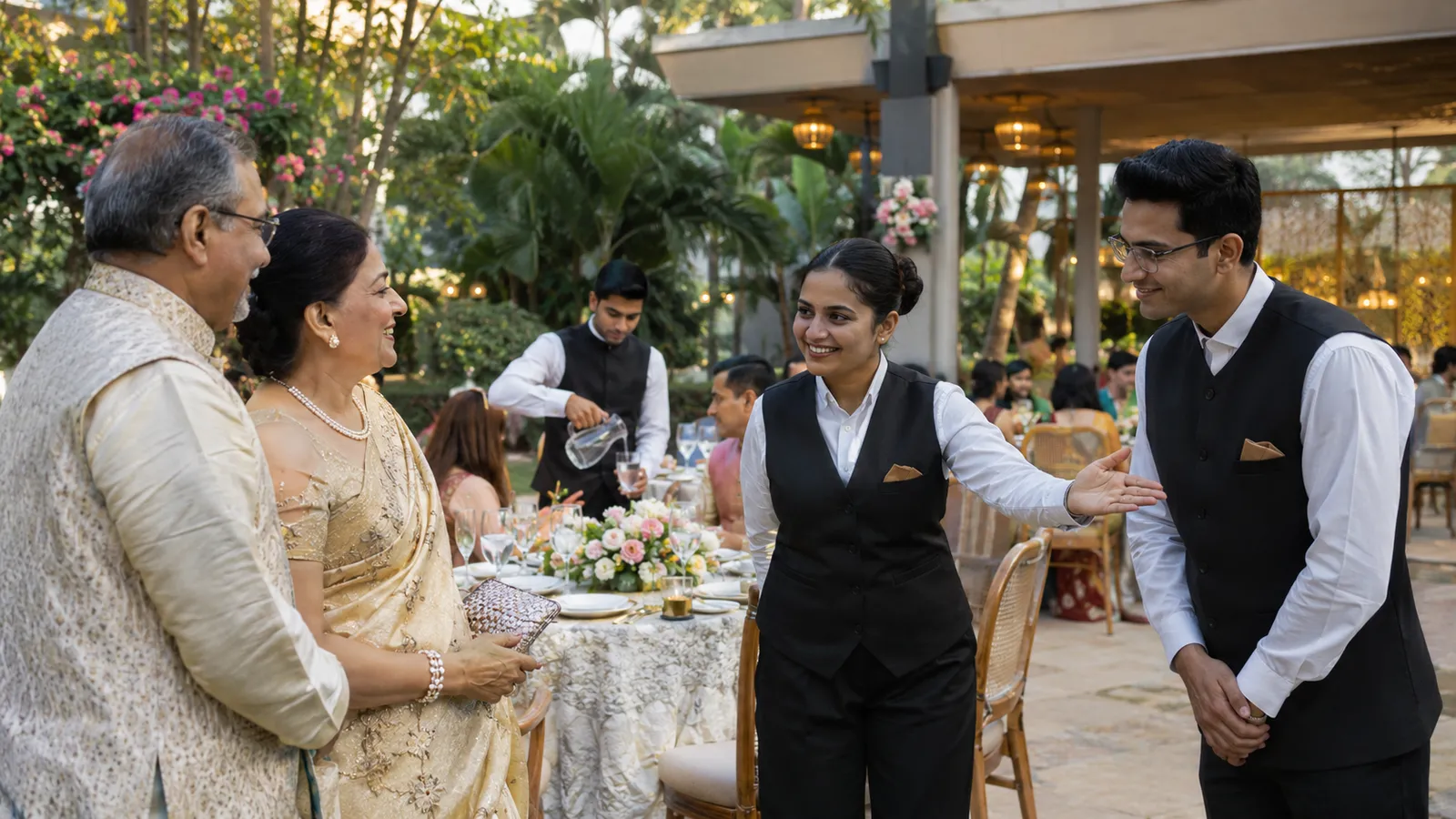
The flowers can be exactly right. So can the lighting, the linen and the entrance installation. Yet a guest who cannot find a seat, get a glass of water or locate their car at the end of the evening may leave feeling poorly looked after. A beautiful setting does not automatically create a comfortable occasion.
That is the real distinction behind luxury event staffing. Décor gives a gathering its visual character; service makes it work for the people attending. Both deserve investment. But when budgets become tight, reducing the service team to protect another decorative feature can undermine the experience the entire event was designed to create.
The difference between an impressive room and a welcoming event
Guests do not experience an event as a floor plan. They experience a series of moments: stepping out of a car, finding the hosts, joining a conversation, sitting down to eat and deciding when to leave. Each transition needs attention, especially when several activities happen in different parts of a venue.
Imagine an older relative arriving at a farmhouse celebration while most guests are outside for photographs. A staff member who knows where to find a chair, whom to inform and how to offer assistance can make that arrival comfortable. This is an illustrative example, not an extravagant service gesture. It is simply someone noticing what the occasion requires.
Give hospitality a place in the budget early
It is easy to approve things that can be seen in a proposal. A floral arrangement has a photograph. A stage has a drawing. Staffing often appears as a number beside a daily rate, which makes it tempting to treat every service quotation as interchangeable.
Ask what that number actually covers. Does it include a supervisor? Is there separate coverage for reception and dining? Who manages clearing while others serve? What happens when people take breaks? A lower quotation may be suitable, but only if it covers the responsibilities your event needs. Compare the scope before comparing the total.
Protect the less visible essentials too: time for the team to arrive and prepare, a proper briefing, drinking water and planned rest breaks during a long function. These provisions are not decorative extras, but they affect how people work. Confirm overtime arrangements and the expected finish time in advance so an extended celebration does not turn into a disagreement while guests are still being served.
There is no useful universal staffing ratio for every luxury gathering. A seated dinner, a buffet reception and a standing cocktail evening involve different workloads. Venue distances, service style and the timing of guest arrivals matter alongside the invitation count.
Service should support the design, not fight it
The best planning conversation brings the hospitality lead and event designer together before the layout is fixed. A statement table arrangement should still leave enough room for plates and comfortable conversation. A dramatic entrance should not make guest queues spill into the vehicle drop-off area. These are practical design decisions, not arguments against creativity.
Walk the service routes as well as the guest routes. Can staff carry trays without squeezing between chairs? Is there a discreet place for used glassware? Can the kitchen reach the dining area without crossing the main performance space? Resolving these questions early lets the setting remain elegant once the room is full.
Match the people to the kind of gathering
An intimate anniversary dinner does not need the same deployment as a wedding reception. For a private meal, event butler services can provide attentive table service and coordination with the kitchen. A larger gathering may need dedicated welcome staff, beverage teams, dining attendants and a supervisor who can move between zones.
Weddings introduce another layer of coordination. A family may move between ceremonies, photographs, meals and guest greetings, with different priorities at each stage. When discussing wedding staffing services, explain those transitions rather than supplying only the overall guest count. Clarify who communicates changes on behalf of the family so staff do not receive conflicting instructions.
Personal attention does not mean constant interruption
Good hospitality is attentive without making guests feel watched. Repeatedly asking whether everything is all right can interrupt the very conversation someone came to enjoy. Staff need to recognise a suitable moment to approach, offer help clearly and allow people space when they decline.
Personal preferences also need sensible handling. If a guest asks about an ingredient, the correct response is to check with the catering team rather than offer an uncertain reassurance. If someone requests a quieter seat, the team should know who can arrange it. Thoughtful service depends on reliable information, not on promising to fulfil every request immediately.
Privacy belongs in the service briefing
At a private celebration, discretion is part of making people comfortable. Guests should not have to wonder whether a casual conversation, an arrival or a family moment will become somebody else’s social media post. Explain photography rules and information-sharing expectations to every person working in guest-facing areas.
Also distinguish hospitality responsibilities from security responsibilities. A welcoming manner does not give staff authority to admit an unlisted visitor or disclose where a particular guest is seated. Give them a named contact for decisions. That allows them to remain courteous without guessing or discussing a private matter in front of other attendees.
Leave room for the evening to change
An outdoor reception can move indoors. A ceremony may finish later than planned. Several guests may arrive together when the original schedule suggested staggered arrivals. These are useful planning scenarios, not reasons to expect the worst. A supervisor needs an agreed way to communicate changes to reception, dining and the venue team.
Elite Butlers’ published Delhi wedding staffing case study describes a deployment affected by heavy rain. Its relevance is not that every gathering needs the same response, but that staffing discussions should include disruption as well as the intended programme. Ask who can reassign duties, who coordinates with the planner and how updated instructions reach the team.
What should remain with your guests
After a gathering, the photographs preserve the setting. The host’s own recollection may depend just as much on whether they spent the evening with guests or repeatedly solving service problems. That is a useful test when reviewing an event budget: will this decision help people enjoy the occasion, or mainly improve how an empty venue looks?
Elite Butlers provides luxury event staffing for private celebrations, weddings and corporate occasions in India. Start the conversation with the venue, guest profile, service format and moments that need particular care. Keep the décor that gives the occasion meaning, and give the people delivering hospitality an equally considered brief. A memorable celebration should feel as welcoming as it looks.
