
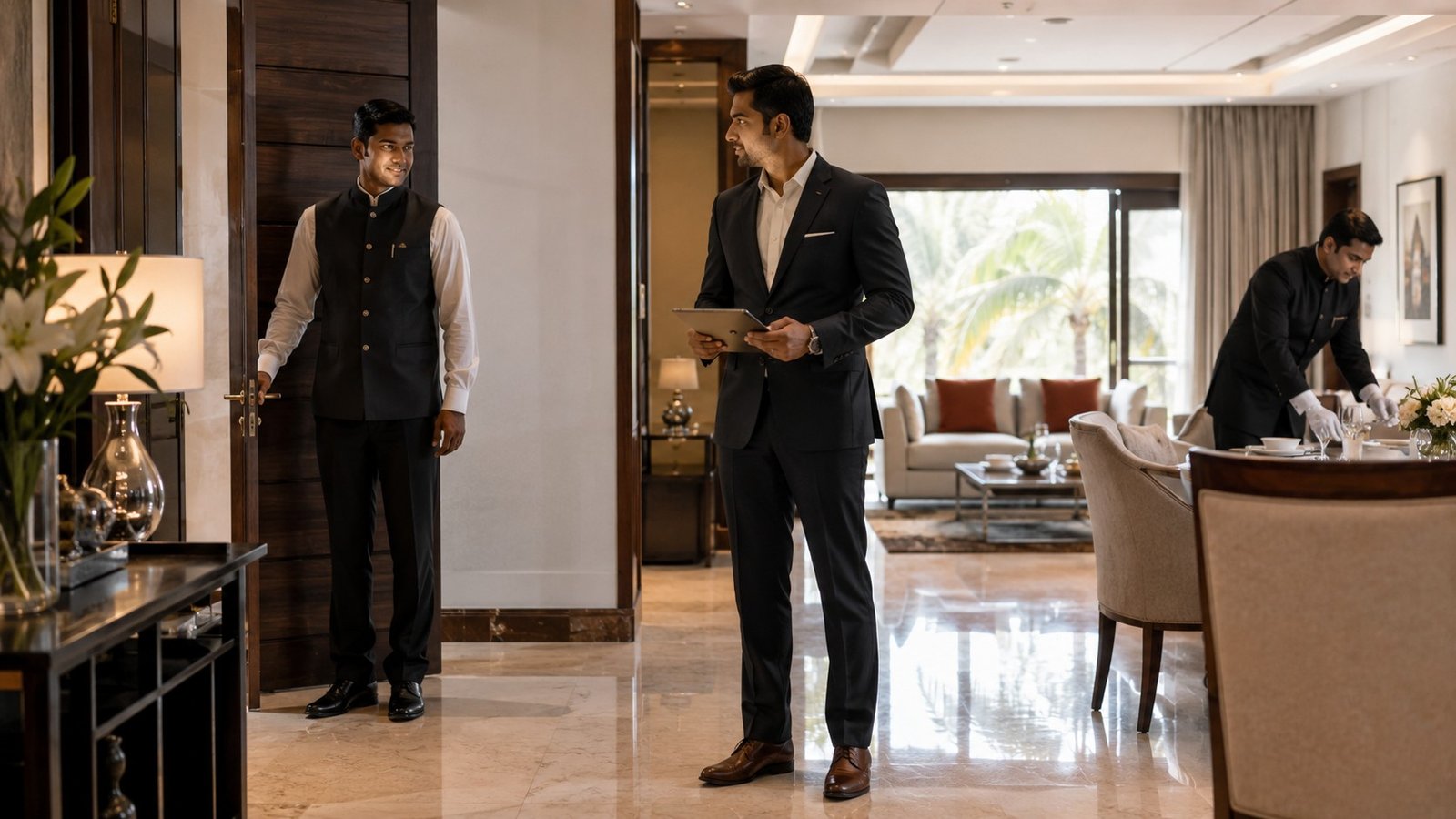
I walked into a 20,000-square-foot duplex in South Mumbai a few months ago and counted six things wrong before I reached the living room.
The shoes of the previous visitor had been left untidily in the foyer. The two staff who greeted me were in subtly mismatched uniforms – same colour, different cuts. A phone was ringing in another part of the house, and no one was moving toward it. The temperature was set too cold, which is a Mumbai HNI signature I see again and again: an unconscious confusion between cooling and luxury.
There was no scent in the foyer, which is a missed opportunity. And there was no offering of anything to me, the visitor – no water, no acknowledgement, no choreography of arrival.
The principal of the home, a remarkable woman who has built a business I deeply admire, had no idea any of this was happening. She had no idea because no one told her. No guest will ever tell her. Her staff will not tell her. Her family will not tell her, because they have grown up in the home and do not see it as visitors do.
This is the work of a hospitality audit. It is the work of being the one person in the room who is willing to tell the truth.
Indian HNI homes are built with extraordinary care. The architect is internationally trained. The interior designer is one of perhaps ten who matter in the country. The art consultant has been carefully chosen, often over years. The kitchen is designed by a specialist. The lighting designer is flown in. Nothing about the hardware of the home is left to chance.
And then the staff are hired through word of mouth, trained by whoever happened to be there before them, dressed in uniforms ordered by an office assistant, and managed by no one in particular.
The asymmetry is staggering. A home worth a hundred crores is being run, operationally, the way a small family business might have been run forty years ago.
This is not a criticism of the principals. It is a structural problem in the way Indian luxury has evolved. The hardware caught up to global standards. The software did not. Most HNI residences today are five-star hotels that no one ever trained as five-star hotels. This is exactly why HNI private staffing must be supported by systems, training, and accountability.
When we conduct an audit of a private residence, we are not inspecting. We are listening. We listen for the gap between what the home is trying to say and what it is actually saying.
We listen at the gate first. Is the security guard standing or seated? Does he stand for every car or only some? Does he know which family members are arriving and which are guests? Has he been trained in how to greet a senior visitor versus a delivery? Most security teams in Indian HNI residences have been trained extensively in suspicion and not at all in warmth, and the result is that the visitor’s first impression of a hundred-crore home is a flat, indifferent gesture from a man in a uniform that does not fit him.
We listen at the front door. Who opens it? With what energy? Does the staff member know your name, or does he look surprised to see you? Is there a soft transition from the outside heat to the inside cool, or is it a hard slap of cold air? Is there a scent? Is there music? Is there a deliberate choreography to the first thirty seconds, or is there only the absence of one?
We listen in the kitchen. We listen to the way the head cook speaks to the assistant. We listen for whether there is a daily standup or whether the morning begins in chaos. We listen for the assumptions that have hardened into rules, the “we have always done it this way” that is the single most expensive sentence in any household.
We listen to the laundry chain, which is where most luxury homes lose the most reputation among their most frequent guests. We listen to the linen rotation, the towel folding, the placement of slippers, the temperature of the guest bedroom, and the offering at the bedside.
A dinner party where the principal’s mother-in-law was offered drinks before the principal’s wife. A cultural disaster, conducted in slow motion in front of forty guests, and never spoken of again.
The driver who did not step out to open the door for a visiting client because no one had ever told him this was expected. The visiting client noticed. The principal did not. The client, in conversation with a mutual friend three weeks later, mentioned it once. The deal that the visit had been about did not happen.
The “uncle” maid who has worked in the home for twenty-two years and runs the household on her own logic. Beloved by the family, immovable, untrained, and the source of about forty percent of the friction every other staff member experiences. The principal cannot remove her and does not want to. We do not ask them to. We work around her, with her, and gently bring her into a system she did not know she was missing.
The repeat business partner who has visited the home three times and has not been recognised by the staff on any of those visits. He says nothing. He notices everything.
These moments are why documented household systems matter. Our piece on luxury hospitality SOP audits explains how written standards reduce dependence on memory and personality.
We have learned, over many engagements, that you cannot fix a residence by handing the staff a manual. They will not read it. They have been told things before. They will nod and continue.
What works is the mirror. We come in for two to three days. We watch, we listen, we record. We then sit with the principal and walk them through their own home as a guest would see it. We do not lecture. We point. We show. We replay the morning chaos. We describe the smell of the foyer at 6 am. We name the moment when the staff hierarchy broke down at dinner.
Most principals are quiet for a long time in that meeting. And then they say some version of the same sentence: “I never knew.”
That is the beginning of the work. The training that follows – staff onboarding, daily routines, guest protocols, kitchen choreography, security warmth, laundry standards, scent and sound design – comes from the gap that the audit has made visible. This is where residential staffing training becomes meaningful, because it is built around what the home actually needs.
A home cannot be elevated until it is first seen clearly. Our job is to see it on your behalf and to tell you the truth that no one else in your life is positioned to tell.
For households that depend on butlers, house managers, chefs, drivers, security, and service teams, this clarity is not cosmetic. It is operational. It affects how guests are received, how teams communicate, how service standards are maintained, and how the home feels every day.
That is why a quiet audit is often the first step toward a more graceful home.
– Vipul Chauhan
